I Put NAM A2-Lite Inside an iRig HD X
The iRig HD X on my desk used to send guitar audio to another computer for processing. It does the amp modelling itself now.
Guitar → iRig codec → NAM A2-Lite → headphones or amplifier
The model runs on the 500 MHz microcontroller already inside the interface. USB supplies power. The wheel still controls the headphone volume. The sound coming out is a 5150 capture with an OD808 in front, rendered in real time inside the iRig.
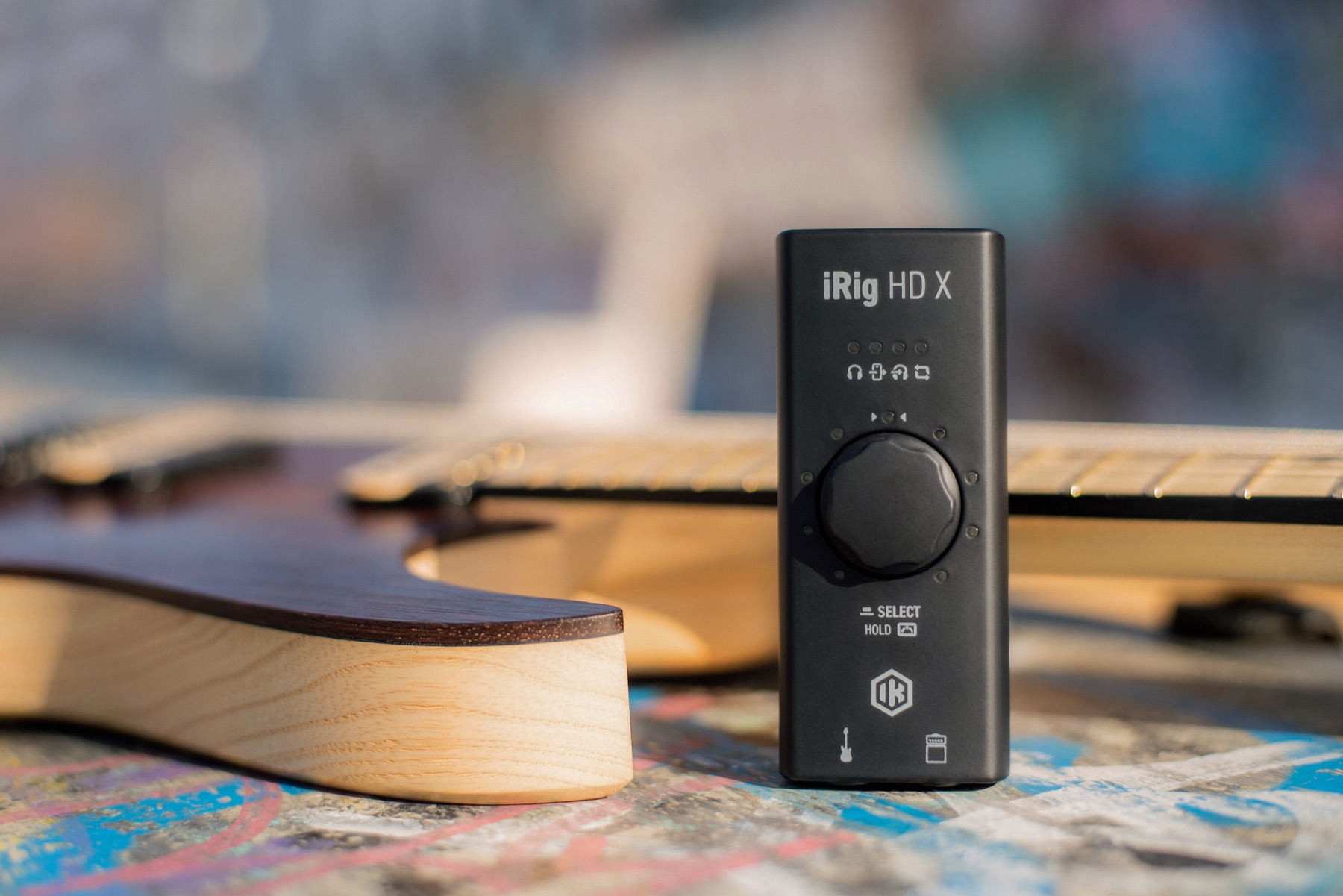
Photo from IK Multimedia's official iRig HD X image gallery.
There was a computer in the interface
This started immediately after I rewrote the HD X's USB audio path. That work made the interface usable with the ESP32-S3 in my pedal prototype. Once I had a firmware readback and understood how the box moved audio, the larger chip on the board became hard to ignore.
The HD X is built around an NXP MIMXRT1011DAE5A: a 500 MHz Cortex-M7 with hardware floating point, tightly coupled memory, external QSPI flash, SAI audio and eDMA. Its normal job is to configure the codec, move samples and handle the controls. Most of the processor was waiting between audio interrupts.
NAM A2-Lite was designed for exactly this kind of machine. It is the compact member of the A2 family we use in Taurus: one recurrent amp model and 48 kHz audio. I used a 5150 capture with an OD808 in front by jp_is_out_of_tune that I had found online—the same model I had been using throughout the embedded tests.
I wanted the whole path inside the interface. The codec would capture the guitar, the RT1011 would run the model, and the codec would play the result. The ESP32-S3, Mac and phone could all disappear from the audio path.
Fitting the engine into 128 KiB
The processor has four 32 KiB FlexRAM banks. Those banks can become instruction TCM, data TCM or ordinary on-chip RAM at boot. A2-Lite's engine object takes 91,204 bytes, so the usual memory layout was useless.
I configured three banks as DTCM and one as OCRAM:
| Region | Size | What lives there |
|---|---|---|
| DTCM | 96 KiB | A2-Lite weights and convolution history |
| OCRAM | 32 KiB | DMA buffers, program data and stack |
| External QSPI | 2 MiB | Executable code, constants and the model file |
The compact model is 7,516 bytes. It stays in flash until startup, then its weights and history land in DTCM. The final live build uses 91,232 bytes of DTCM, leaving 7,072 bytes free. OCRAM usage, including the reserved stack, is 10,664 bytes. That leaves 22,104 bytes for the audio machinery and anything else the firmware needs to survive.
From 48 frames to 16
I brought the engine up with 48-sample blocks. At 48 kHz, each block lasts one millisecond and gives a 500 MHz processor 500,000 cycles.
The physical null-test run measured:
| 48-sample block | Cycles |
|---|---|
| Minimum | 442,052 |
| Mean | 442,108 |
| Maximum | 442,260 |
| Deadline | 500,000 |
The worst block used 88.45% of the available time and returned with 57,740 cycles left.
I tried the Cortex-M7's DSP instructions first. A staged layer-major implementation took 662,042 cycles. My hand-written two-frame convolution kernel took 1,001,381. Both missed the audio deadline.
The fastest version was the portable whole-model floating-point engine. The M7's cache, FPU and compiler already agreed on a better schedule than my manual kernels. I removed the clever code and kept the version that finished on time.
I later cut the live buffer to 16 frames, or 0.333 ms. Its deadline is 166,667 cycles. The final firmware keeps streaming through a late block. If either four-entry DMA queue falls behind, it restarts both SAI streams; a fault becomes an audible click or dropout and playback resumes.
Turning the interface into the pedal
The replacement firmware configures the original codec over I2C and streams stereo audio through SAI with eDMA. Each completed input block is converted to float, fed through A2-Lite, converted back and queued for playback. The second output channel carries the same processed signal so the headphone and amplifier paths behave normally.
The physical wheel continues to set headphone level. This became urgent when the first live build came up painfully loud. Once the wheel worked again, I could play it like the original interface.
In live mode the USB cable powers the HD X. Audio stays on the board:
- The codec samples the guitar at 48 kHz.
- eDMA fills a 16-frame input block.
- A2-Lite renders the 5150 capture.
- eDMA sends the result back to the codec.
- The headphone and amp outputs play it.
I plugged a guitar and headphones into the iRig and heard the model with no host computer in the signal path. The USB interface had become the entire pedal.
Against upstream NAMCore
I rendered the same 15-second, 48 kHz guitar recording through upstream NeuralAmpModelerCore using the original .nam capture. A temporary iRig firmware returned the RT1011's processed samples over USB for comparison; I restored the live firmware after recording them.
The physical iRig and upstream NAMCore aligned at zero samples. Here is the null over the steady part of the render, after the first second:
| Measurement | Result |
|---|---|
| Relative null | −115.63 dB |
| Correlation | 0.9999999999985 |
| Largest sample error | 2.811 × 10⁻⁶ (−111.0 dBFS) |
| Residual RMS | −131.83 dBFS |